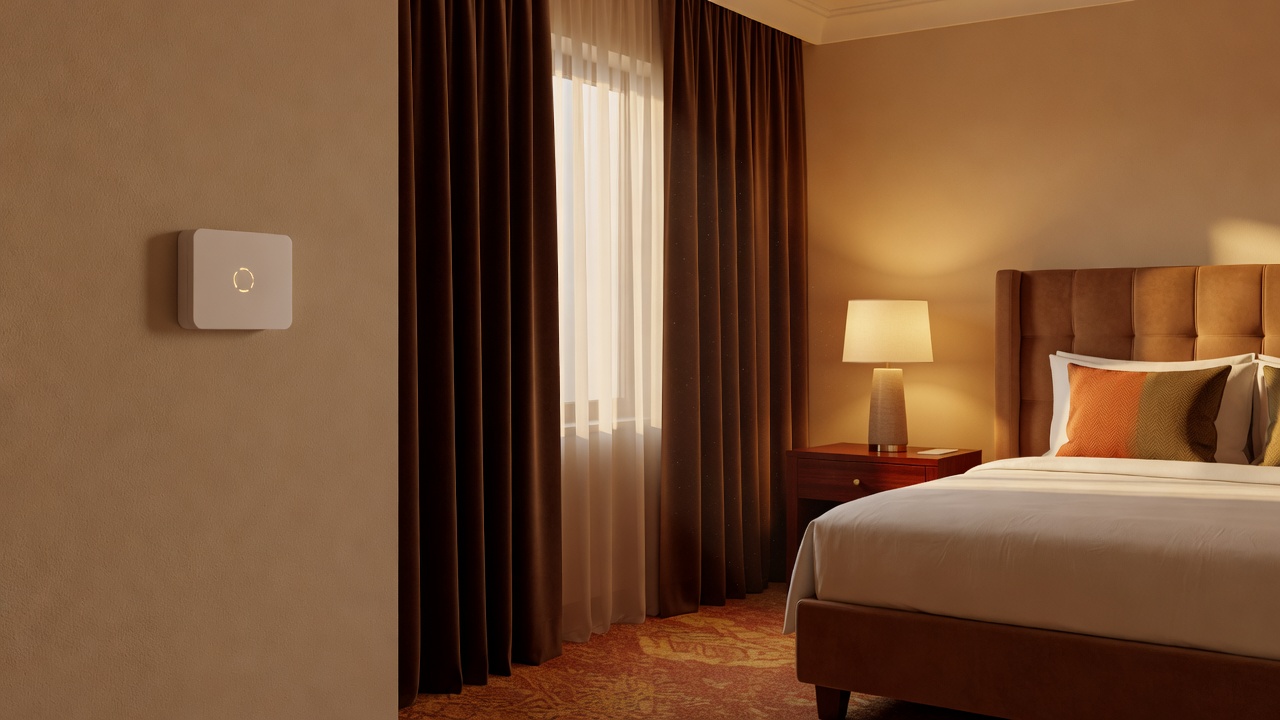
Make the room, not the device, the unit of understanding
A hotel room is a changing environment. People, sunlight, cooking appliances in suites, outside air, open windows, bathroom moisture and heating or cooling equipment all influence what a guest experiences. An environmental sensor provides a limited observation of that environment at one location and moment. A sensible control design combines readings with room state and equipment behavior, and recognizes that a number is not the same as a complete description of comfort.
Begin by listing the decisions the property wants to make. Is the goal to recognize a room that is warming despite a cooling call? To avoid conditioning against an open window? To identify a sensor that has stopped reporting? To prepare a room before arrival? Each question may need different inputs. Adding sensors without a defined operational use increases installation, support and data-management work without necessarily improving decisions.
Temperature: placement shapes meaning
Room temperature is often central to HVAC control, but measurement quality depends on placement. A device in direct sunlight may report a local warm spot rather than representative room conditions. A sensor near an exterior door, a supply-air outlet, a television or a lamp can be biased by drafts or heat. Installers should consider mounting height, wall construction, airflow, furnishings and guest interaction. A location should be accessible enough for maintenance but not so exposed that luggage, curtains or a guest's hand routinely obstruct it.
Commissioning should compare sensor readings with a suitable reference under different operating conditions, not only during a quick installation check. Look for implausible jumps, persistent offsets and slow responses after HVAC changes. A trend line can reveal a sensor that is stuck at one value or reporting intermittently. Define acceptable ranges and a practical alert route, then ensure the fault state leads to a safe control behavior rather than an aggressive response based on stale data.
Humidity and moisture context
Relative humidity adds context to perceived comfort and moisture management. It changes with temperature, ventilation, bathing and outdoor conditions, so a reading should be interpreted alongside temperature and room use. A single brief spike after a shower may be expected; a persistent condition may call for inspection of ventilation, seals or equipment. Controls should not infer a building defect from one noisy measurement, nor should they ignore a recurring pattern simply because the thermostat target is being met.
Choose equipment suited to the required range and maintenance conditions. Consider calibration, condensation risk, sensor drift and the effect of placing a device near a bathroom entrance. Establish how operations staff will distinguish a normal transient from a signal that merits follow-up. Environmental trends can help prioritize investigation, but they should not replace a physical inspection when a room has a persistent moisture concern.
Windows, sunlight and outside influence
Window contacts can indicate that a window or balcony door is open, when the room design supports that measurement. Their value lies in context: a cooling system may behave differently when outside air enters, but the appropriate response depends on weather, equipment, room pressure and guest preference. A contact can be misaligned, bypassed or unavailable, so do not let it become an unexamined single-point authority. Make the resulting behavior predictable and clearly communicate it to staff.
Solar gain can create meaningful differences between rooms on different orientations and floors. A window-facing room may warm while a shaded room remains steady, even with similar occupancy and setpoints. Shading position may be detectable in some installations, but the presence of curtains is not a direct measure of guest comfort. If the control strategy uses façade, weather or solar information, validate that data against local room behavior and avoid assuming that all rooms in one building respond alike.
Occupancy and environmental readings together
Environmental data becomes more useful when considered with room presence and operational status. A room that appears vacant but is warming quickly may need a different policy from a room that is stable and confirmed empty. An occupied room with a window open might trigger a gentle notification or bounded adjustment, but the correct choice is a hotel policy decision. Room-management status can provide arrival and turnover context; sensor readings can indicate physical conditions. Record both inputs so teams can understand why a control action occurred.
Combining inputs should not mean collecting everything continuously. Choose only the resolution and retention necessary for the control task. Where practical, store room-level state and trends rather than detailed, high-frequency records. Establish who can access the data, how faults are handled and when records are deleted. Privacy and security review belong in the design phase, not as an afterthought after devices are already installed.
Equipment feedback closes the loop
A system may issue a request without the equipment following it. Fan status, valve position, operating mode, fault codes or a measured change in room conditions can help distinguish an intended command from a real response. The available feedback depends on the installed HVAC and room-control interface. Agree what the integration exposes, how quickly data updates and what happens when communication fails. A command should never be assumed to have succeeded just because it was sent.
Useful monitoring focuses on exceptions a team can act on: a room that repeatedly fails to reach its expected range, an actuator that does not respond, a sensor with stale data, or an unusual pattern that persists. Avoid alert fatigue by routing incidents according to urgency and responsibility. A front-desk team may need a clear room status, while engineering staff may need diagnostic detail. The same raw reading does not need to be presented in the same way to every role.
Commissioning the sensor story
Create a simple sensor register for each room type: measured variable, location, units, update interval, expected operating range, last inspection and associated control rule. Test representative rooms at different exposures and layouts. Verify every sensor against a known reference where appropriate, test disconnection behavior, and confirm that staff can see a fault. Document how a replacement is paired and how a reading is checked after work is complete.
Review sensor performance over ordinary operations and unusual conditions. Include housekeeping, guest feedback, seasonal weather and maintenance observations in the review. When readings conflict, establish which source takes precedence and whether the automation should pause. A well-designed sensor mix offers enough information to make a decision, enough transparency to explain it and enough restraint to avoid pretending that the room can be reduced to a handful of numbers.