Start with an operational inventory
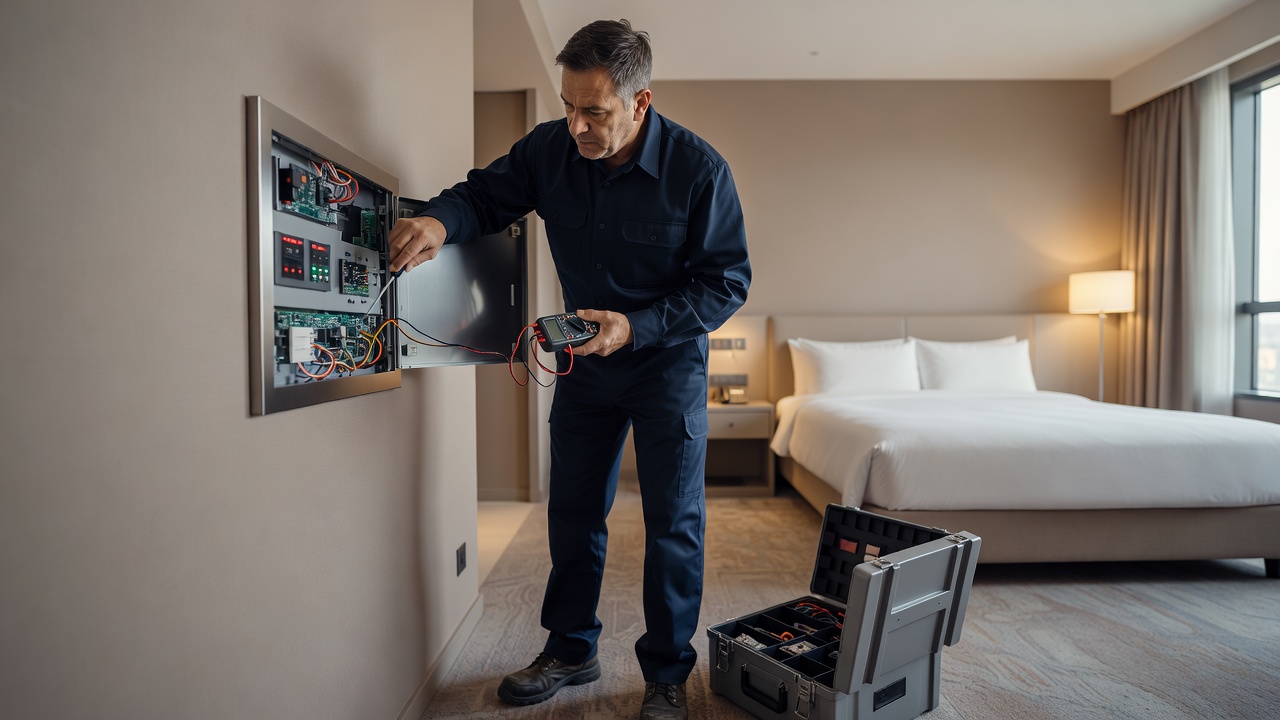
Before evaluating a new control layer, list room types, HVAC equipment, existing thermostats, room-management systems, sensors, communications interfaces and staff workflows. Include suites, accessible rooms, connecting rooms and spaces with different exposure or equipment. Record what is installed, who maintains it, what the control interface can read and write, and where unknowns remain. A useful inventory is concrete enough to help engineering plan a test and guest services explain what might change.
Map important room events: reservation updates, check-in, early arrival, room moves, checkout, housekeeping entry, inspection, out-of-order status and maintenance. Note which system owns each event and how information reaches other systems. If a status can be delayed or manually corrected, document that too. A control policy built on event timing that nobody has verified may create confusing behavior precisely when a hotel is busiest.
Agree goals and guardrails before choosing metrics
Set an operational objective that can be tested without promising a guaranteed saving. Examples include improving visibility into room control states, reducing unnecessary conditioning under a defined vacant-room policy, identifying equipment response problems earlier, or making room preparation behavior more consistent. Pair each objective with a guest-comfort guardrail and a measure the team can collect. A useful test might ask whether the expected room state is visible, whether a guest override behaves as agreed and whether a service issue is routed to the right team.
Decide who approves control limits, who can pause automation and how an exception is reported. Facilities, hotel operations, housekeeping, front desk, IT, security and privacy colleagues may all have responsibilities. Write down how a pilot can be reversed. A property should not depend on a vendor or a single technical specialist to restore a safe standard mode.
Select a representative pilot
Choose rooms that reveal the range of conditions rather than only the easiest installation. Include relevant room categories, equipment types, orientations and operational patterns. A small pilot should be large enough to test installation and support processes, but bounded enough to inspect each room. Agree duration and review checkpoints in advance, and avoid making decisions from an unusual occupancy period without noting that context.
First establish a baseline of current behavior. Record room readiness, guest feedback channels, manual adjustments, relevant faults and available energy data. Confirm the baseline period represents the rooms being tested and note weather, events, refurbishment or schedule changes. If meters are not available at room level, do not imply precise room savings from building-level data. Use the measures the installation can support and state their limits honestly.
Commission every interface and fallback
For each pilot room, verify room identity mapping, sensor readings, HVAC command and feedback, room-state updates, local guest controls, staff overrides and fault alerts. Test realistic sequences: a vacant room becomes booked, an occupied room is briefly still, housekeeping enters, a checkout is delayed, a window is opened, a sensor stops reporting, and the equipment fails to follow a command. Confirm the system's behavior against written expectations, not just a successful dashboard connection.
Document the fallback for network interruption, loss of an external room-status feed, stale sensor values and a failed controller. Confirm whether the local thermostat remains usable. Ensure that a property team can recognize the fallback state and return a room to standard operation. Commissioning records should identify the room, device, test result, date and action required. Unresolved faults should not disappear into a general “pilot complete” status.
Prepare the people who work with rooms
Training should be role-specific. Front-desk colleagues need to understand the guest-facing behavior and how to escalate a comfort concern. Housekeeping teams need to know whether room entry or service status affects the control state. Engineers need access to diagnostics, device locations, replacement procedures and fault histories. Managers need a concise way to review exceptions and determine whether a policy should continue. Do not expect one generic presentation to prepare every team.
Give staff simple language for explaining the system without overselling it. Clarify what is automated, what data is used, how a guest can adjust the room and who can help if the room feels uncomfortable. Invite staff feedback during the pilot: they often notice room-specific behavior that is invisible in a summary chart. Treat their reports as evidence to examine rather than resistance to an initiative.
Review outcomes with context
At each checkpoint, compare actual behavior with the stated goal and guardrails. Look at guest feedback, override frequency, readiness issues, alert quality, sensor uptime, equipment response and energy information where measurement is appropriate. Break results down by relevant room type and operating condition. Check whether a change coincided with a new schedule, maintenance work, altered occupancy pattern or different weather. Do not attribute every observed change to the automation without considering those factors.
Make the decision to continue, revise, pause or expand explicit. Record what the team learned, what remains uncertain and who owns follow-up. If a control rule creates repeated complaints or unexplained behavior, fix that before adding more rooms. A rollout can be successful because it revealed an interface problem early, even if the original policy needs redesign.
Plan scaling as an ongoing service
Expansion needs installation capacity, device stock, access planning, room downtime coordination, cybersecurity review and support ownership. Agree how software changes are reviewed, tested and rolled back. Maintain a register of rooms, equipment and configuration versions. Schedule checks for sensor calibration, device replacement, integration health and staff training turnover. Room control is an operating service, not a one-off technology project.
Finally, set a recurring review that brings engineering and guest-service perspectives together. Revisit policies when the hotel changes room layouts, HVAC equipment, check-in practices or service standards. An approach that works in one season or building may need adjustment elsewhere. Measure carefully, communicate clearly and keep comfort as the boundary within which energy management decisions are made.